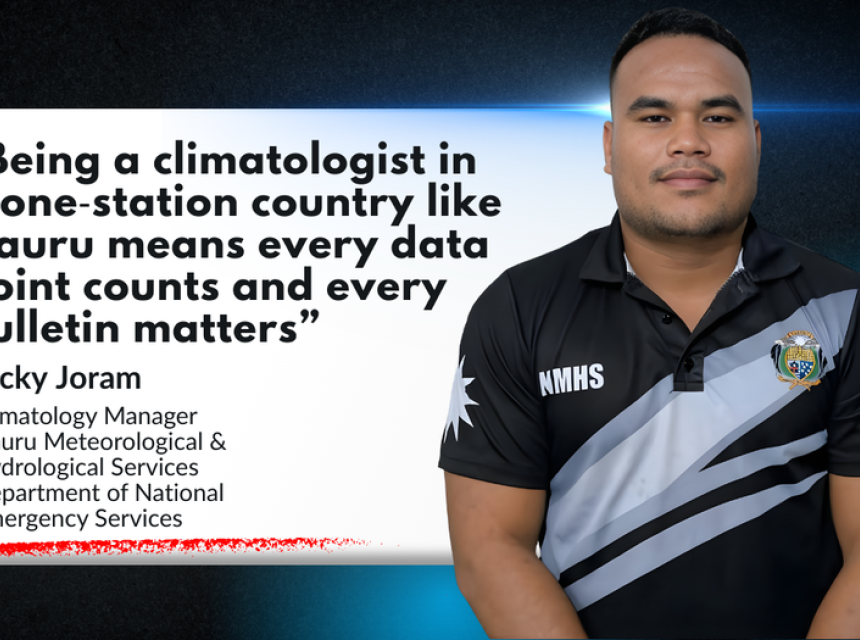
Ricky Joram, Elevating Nauru's Climate Services Through International Training
Ricky Joram is entering a defining phase of his climatology career, leading a three week regional attachment that aims to transform how Nauru gathers, analyses, and shares climate information. This opportunity places him at the centre of efforts to strengthen national climate services and support climate resilient development.
“Being a climatologist in a onestation country like Nauru means every data point counts and every bulletin matters. This attachment is my chance to turn our small office into a stronger service for our people and the wider Pacific,” expressed Ricky Joram.
As Climatology Manager at the Nauru Meteorological Hydrological Services (NMHS), Ricky has designed a “Climatology Section Development and Capacity Building Attachment Programme” with the Fiji Meteorological Services. The attachment programme is a strategic investment in the entire climatology section’s ability to provide accurate, timely, and user focused services. It comes at a time when Nauru is intensifying its focus on climate resilience, requiring stronger evidence and analysis to inform decisions on water, agriculture, infrastructure, and disaster risk reduction.
The opportunity carries strong institutional backing. In a formal letter, Nauru’s Director of National Meteorology Hydrology Services describes Ricky’s proposal as a “great step forward” for the country’s climatology capacity and its contribution to disaster preparedness and national planning. That endorsement underscores how closely the attachment aligns with national priorities.
Ricky currently leads what is effectively a one person climate office with a national mandate. Under his leadership, the climatology section already produces Early Action Rainfall Watch (EAR Watch) bulletins, monthly climate summaries, and rainfall outlooks that keep stakeholders updated on current and expected conditions. Ricky manages Nauru’s climate database through ongoing data entry and quality control in CliDE (Climate Data for the Environment) and participates in regional climate outlook forums, contributing Nauru’s perspective to Pacific wide monthly and seasonal outlooks. Despite limited human resources, the section anchors the country’s climate information system.
The attachment programme is tailored to this context. It focuses on practical workflows that Ricky can adopt and sustain in a small office environment, whilst still aligning with regional standards. Core elements are station data handling, basic quality control, climate monitoring fundamentals, and streamlined CliDE processes suited to a single station network. The guiding principles emphasise a handson approach, building skills that can be applied immediately back in Nauru.
Structured over three weeks, the attachment maps out a clear progression from foundations to more advanced climatology and services. Week one concentrates on the basics of climate data management: manual station workflows, CliDE fundamentals, data quality control, and the building blocks of climate monitoring. Week two shifts into climate analysis and product development, introducing light climate analysis, Data Rescue (DARE), verification of products, and the preparation of sector focused bulletins and climate outlook inputs. Week three consolidates these skills through advanced foundations and DARE basics, culminating in the completion and presentation of a portfolio of climate products.
By the end of the attachment, Ricky is expected to deliver a suite of tangible outputs that double as templates for ongoing work in Nauru. These include climate status snapshots, monthly climate summaries, EAR Watch bulletins, ENSO summaries, Ocean and Climate Outlook input files, sector specific climate bulletins, basic trend charts, and a DARE starter plan.
Each product is designed for Nauru’s one station context, providing models he can replicate and refine once back home. In practice, this means more consistent and informative bulletins, better documented climate records, and clearer messages for sector agencies.
The proposal links these technical gains directly to national resilience. Stronger climate data management and analysis will enhance the NMHS’s ability to provide reliable information on rainfall, temperature, and other climate patterns, which is crucial for sectors such as water resources, agriculture, health, and disaster management. Improved skills in trend analysis and outlook generation will help Ricky and his team interpret extremes and long-term changes with greater confidence and translate those insights into clear, sector specific messages. Decisionmakers will be better equipped to anticipate drought, heavy rainfall, or shifts in seasonal patterns and to adjust planning, allocating resources, and preparing communities accordingly.
For Ricky, the attachment is both a professional milestone and a recognition of his growing leadership role in the Pacific climate community. Working alongside a larger regional meteorological service will expose him to established systems for climate monitoring, prediction, verification, and communication. He will have the chance to observe how larger teams manage workflows, coordinate products, and engage users, and then adapt those lessons to Nauru’s unique scale and constraints. That experience will position him as a stronger bridge between national needs and regional initiatives.
For Nauru, investing in Ricky’s development is a strategic move with multiplier effects. A more skilled climatology manager means more robust climate databases, better designed bulletins, sharper participation in regional forums, and more informed national policy dialogues.
As climate risks intensify across the Pacific, this latest opportunity represents both an important step in Ricky Joram’s career and a deliberate effort by Nauru to elevate its climate services and its voice in regional climate conversations.
- Log in to post comments