EL NIÑO LIKELY BY MID-2026, PACIFIC ISLANDS CLIMATE OUTLOOK FORUM-18 WARNS
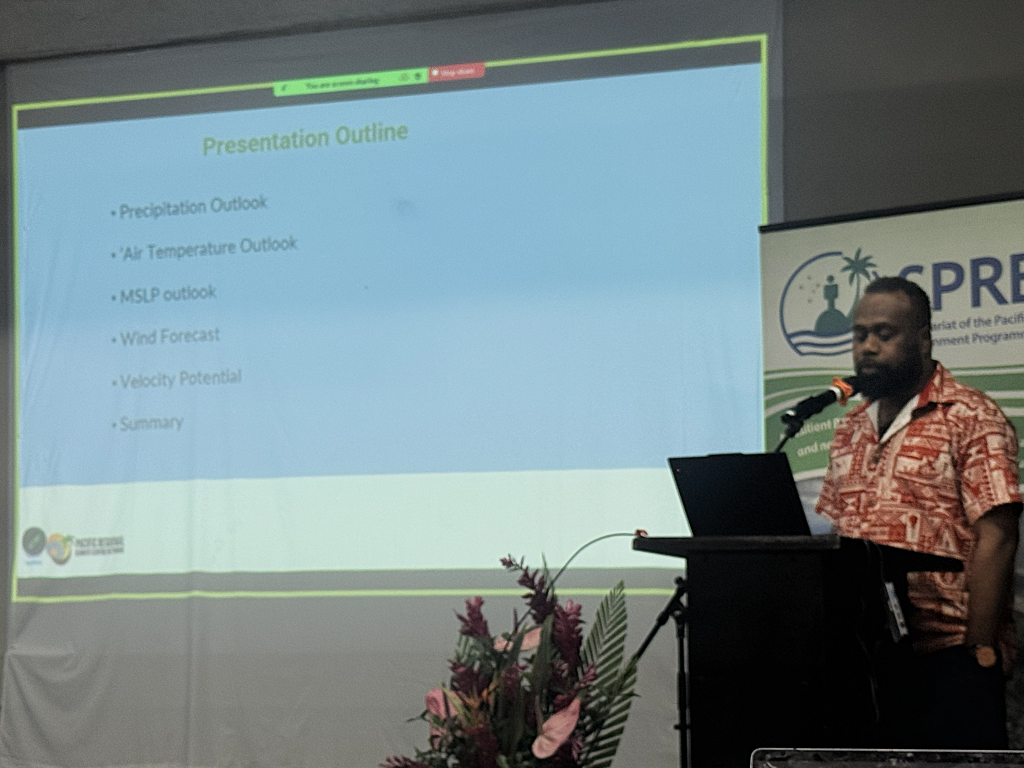
El Niño conditions are likely to develop by mid-2026, according to the 18th Pacific Islands Climate Outlook Forum (PICOF-18) which was held over 23–24 April 2026 in Nadi, Fiji. The forum, coordinated by the WMO RA-V Pacific Regional Climate Centre Network, convened experts from across the Pacific to assess current climate conditions and provide seasonal outlook guidance.
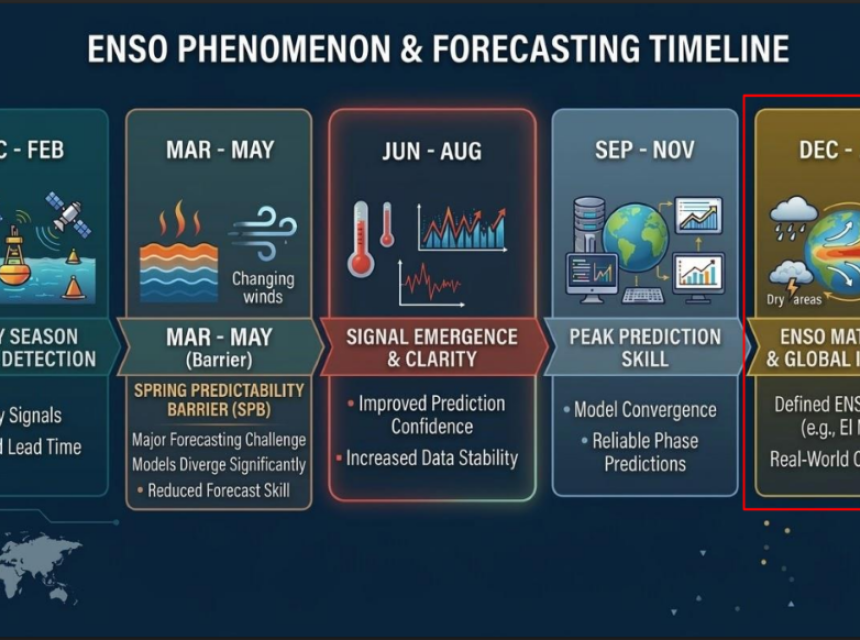
The El Niño-Southern Oscillation (ENSO) is currently neutral but a shift toward El Niño is likely by mid-2026, with conditions likely persisting through the end of the year. However, uncertainties remain about the event's magnitude. The outlook will be refined as new data becomes available.
Rainfall and Temperature Outlook
For the May to July 2026 period, above-normal rainfall is favoured across most of the Micronesian islands north of the equator, Nauru, and the northernmost islands of Kiribati. Above-normal rainfall is also favoured for southern French Polynesia. Below-normal rainfall is favoured for the same period across Palau, much of Melanesia from Papua New Guinea southeast to Fiji, most of Polynesia as well as the Phoenix and southern Line Islands of Kiribati. This pattern is expected to become more pronounced from August to October as conditions shift toward El Niño.
Air temperatures for May to July are favoured to be above-normal across most of the region with near normal across southern Papua New Guinea, New Caledonia, Fiji, Tonga, and Niue. By August to October, the area of near-normal temperatures extends further east, with below-normal air temperatures over north-eastern Fiji and northern Tonga, Niue, southern Cook Islands and southern French Polynesia. Above normal temperatures are favoured elsewhere.
Ocean Conditions and Marine Impacts
Above-normal sea surface temperatures are favoured across most of the equatorial Pacific from May to October, with cooler-than-normal waters likely between Tonga, Samoa, and the Southern Cook Islands later in the period.
Sea levels are favoured to be above normal around Nauru and Kiribati, and below normal across the Federated States of Micronesia and the south-western Pacific during May to July.
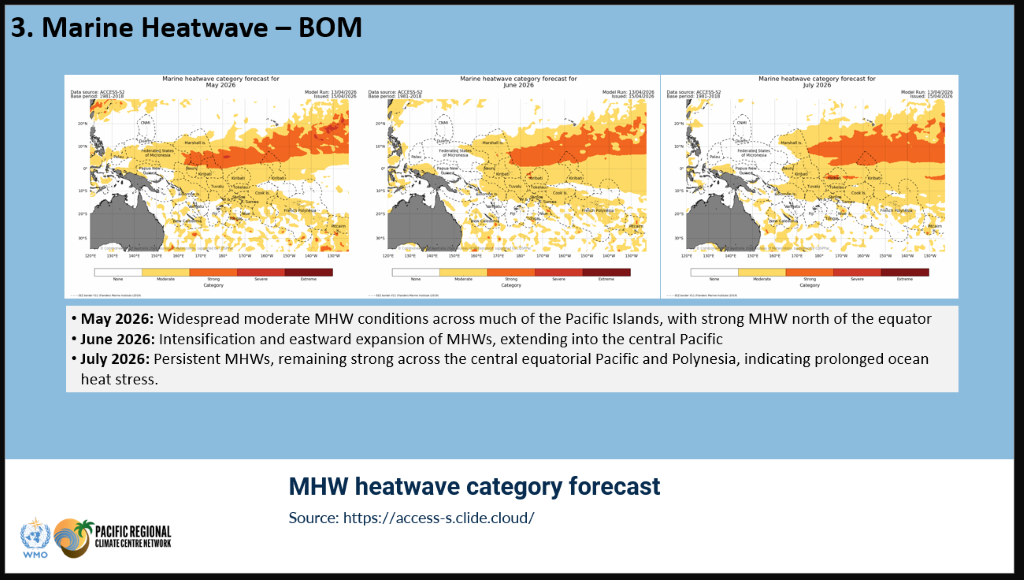
Marine heatwave conditions are predicted across most Pacific Islands from May to July, with greater intensity north of the equator and east of the Date Line. These conditions are expected to persist into the central and eastern Pacific through July.
Coral bleaching alerts have been issued for Nauru, Kiribati, and Samoa in the four-week outlook to 4 May. These alerts are expected to expand in coverage and intensity over the coming weeks, spreading into southern Marshall Islands, northern Tuvalu, and broader areas of central and eastern Kiribati. By the 12-week outlook to 29 June, coral bleaching alerts also extend to Palau and western Federated States of Micronesia.
The Fisheries Convergence Zone is likely to shift eastward and along the equator during the May to July period, which may have implications for tuna fisheries across the region.
Tropical Cyclone Outlook
Tropical cyclone activity in the western North Pacific began earlier than usual in 2026, with four tropical cyclones forming by 21 April. With developing El Niño conditions, tropical cyclone activity is expected to shift eastward towards the Marshall Islands. Above-normal tropical cyclone activity is anticipated for the western North Pacific, while for the far-western Micronesia and Palau below-normal activity is likely. The official NOAA tropical cyclone outlook is expected to be released around 1 June 2026.
Preparedness and Next Steps
Communities are encouraged to monitor updates from their national meteorological services and prepare for potential changes in climate and ocean conditions.
Notes to editors
About PICOF: The Pacific Islands Climate Outlook Forum is held twice yearly to produce regional climate and ocean outlook guidance for Pacific Island countries. It is convened by the WMO Pacific Regional Climate Centre Network with SPREP serving as coordinator.
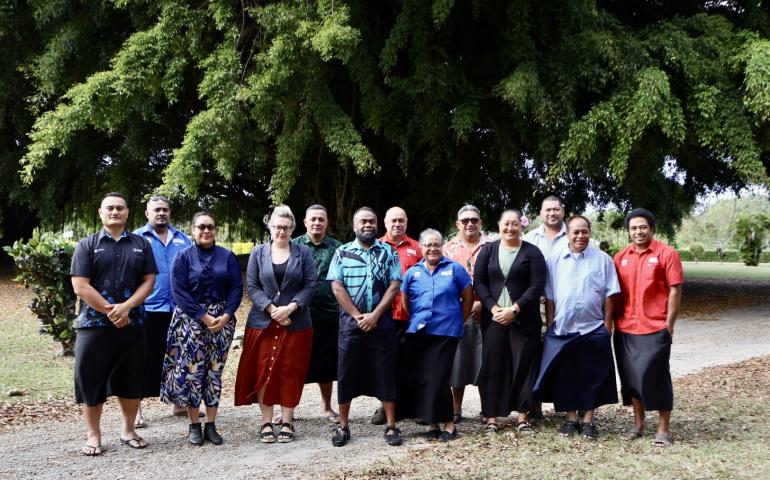
PICOF-18 was attended by representatives from American Samoa, Australia, Cook Islands, Fiji, French Polynesia, Kiribati, Marshall Islands, the Federated States of Micronesia (Chuuk and Pohnpei), New Caledonia, New Zealand, Niue, Palau, Papua New Guinea, Samoa, Solomon Islands, South Korea, Tokelau, Tonga, Tuvalu, the United States of America, and Vanuatu.
Participating organisations included the Secretariat of the Pacific Regional Environment Programme (SPREP), the World Meteorological Organization (WMO), the Pacific Community (SPC), the Australian Bureau of Meteorology, the United States National Oceanic and Atmospheric Administration (NOAA), Météo-France, Earth Sciences New Zealand, the APEC Climate Centre, Seoul National University, the Pacific Catastrophe Risk Insurance Company (PCRIC), and the United Nations Environment Programme (UNEP).
- Log in to post comments