Concept Note and Agenda
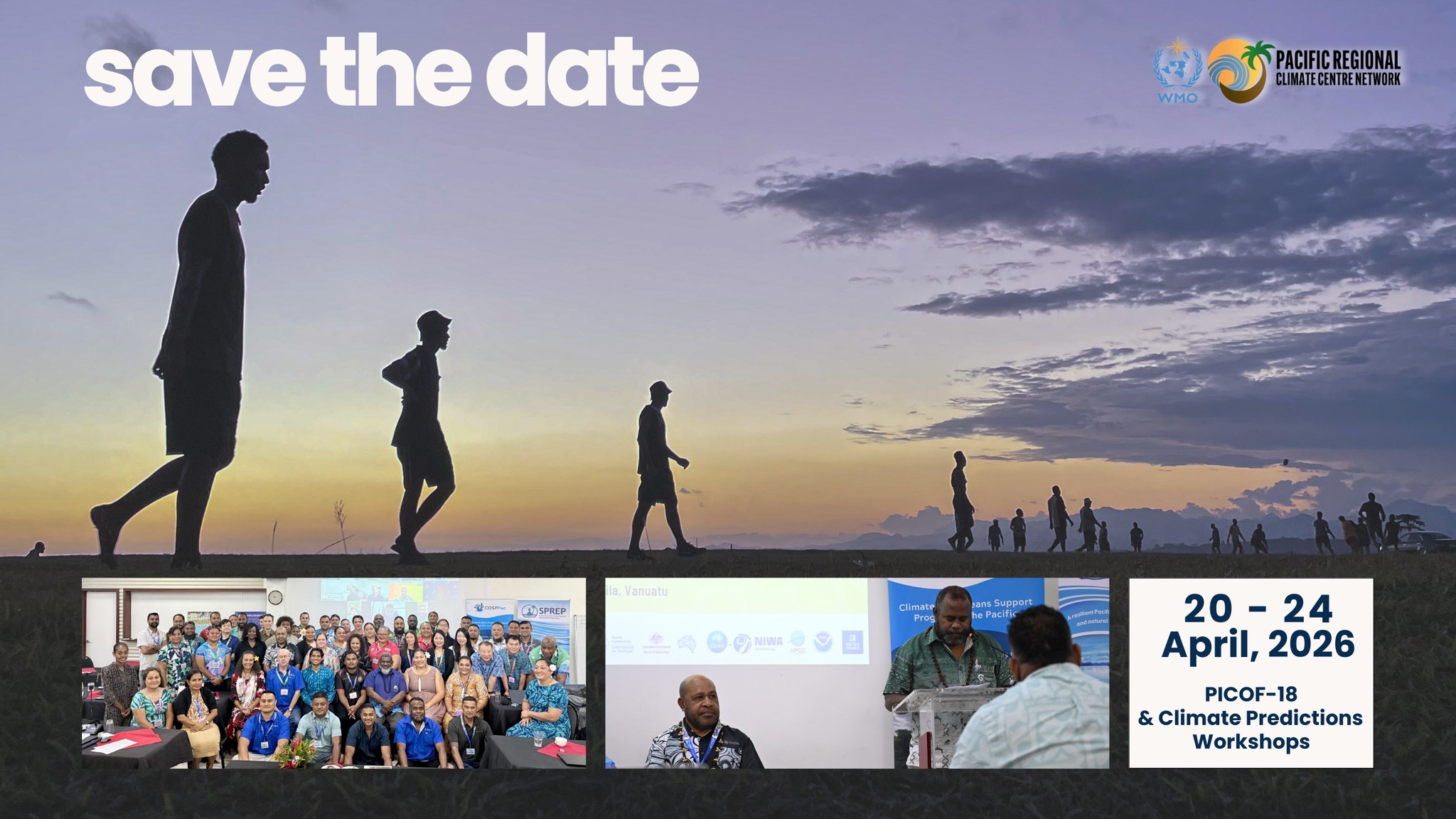
Pacific Islands Climate Outlook Forum – 18 (PICOF-18)
23-24 April 2026
Hybrid: Nadi, Fiji and via Zoom
The Pacific Islands Climate Outlook Forum (PICOF) is based on the World Meteorological Organization (WMO) Regional Climate Outlook Forum concept.
The PICOF is co-organised by the Secretariat of the Pacific Regional Environment Programme (SPREP) and the World Meteorological Organization (WMO) Pacific Regional Climate Centre Network (RCC-N), with technical support provided by the Australian Bureau of Meteorology (BOM), Earth Sciences New Zealand (ESNZ), APEC Climate Centre (APCC), Meteo-France, US National Oceanic and Atmospheric Administration (NOAA), Pacific Community (SPC) and the University of Hawaii as members of the Pacific RCC-N Node for Long-Range Forecasting in partnership with the Pacific Islands Climate Services (PICS) Panel. The latter ensures the needs of National Meteorological and Hydrological Services (NMHSs), and their stakeholders are met. The sponsor of PICOF-18 is SPREP CLIMSA. Ongoing BOM, SPREP and SPC support is largely funded by COSPPac.
Additional information on PICOF and the WMO Pacific RCC Network is available via the Pacific Met Desk Website
Overall objective: To discuss and produce objective, user-relevant regional climate and ocean outlook guidance in real time to support Pacific Island Countries and Territories (PICTs) NMHSs produce national climate and oceans climate information for their national stakeholders, with the ultimate aim to reduce climate-related risks and support sustainable development for the coming season in sectors of critical socioeconomic significance.
Objectives:
Review the climate and oceanic conditions in the western Pacific region for the period November 2025 to April 2026;
Present and discuss long-term trends and projections for selected climate and ocean variables;
Present monthly and seasonal climate, ocean and tropical cyclone outlooks for the Southwest Pacific region for the period May to October 2026;
Discuss and review confidence/skill associated with May to October 2026 outlooks based on the discussions associated with 1-3.
Expected Outcomes:
Improved understanding of climate and ocean monitoring and prediction specifically for the target monitoring and prediction periods.
Enhanced understanding of outlook confidence/skill for the period in question;
A regional PICOF statement containing climate, ocean and tropical cyclone outlooks for May to October 2026 which NMHSs can use as guide to develop their national statements;
A PICOF-18 report;
Content for regional partner and NMHSs climate and ocean bulletins as well as media and social media releases.
Registration Form
To register for the Eighteenth Pacific Islands Climate Outlook Forum (PICOF-18) click on the registration link: here
PICOF-18 Agenda
Day 1 - Thursday 23 April, 2026.
| Time | Agenda Item | Responsible |
|---|---|---|
9.00am-9.30am (0600hrs Palau time, 1100hrs Honolulu time and 2100hrs UTC) | Registration
| SPREP |
| 9.30am-10.00am | Opening and Setting the Scene
Opening prayer
Opening remarks
Meeting objectives | MC – Sunny Seuseu
TBC
PICS Panel/RCC Management Committee Chair |
| 10.00am-10.30am | Morning tea and PICOF-18 official photograph | |
| 10.30am-11.00pm | Session 1: ENSO Status and Outlook Including highlights from Global Seasonal Climate Update (GSCU) | ESNZ, BOM, Meteo-France, NOAA, University of Hawaii, APCC, SPREP, SPC |
11.00am-11.30am
11.30am-12.00pm | Session 2: Looking Back - Review and Evaluation of November to April Climate Outlook i. Atmosphere Overview of November to April state of the climate, plus evaluation of the last PICOF outlook ii. Ocean Overview of November to April state of the ocean, plus evaluation of the last PICOF outlook |
NOAA, University of Hawaii, BOM, SPC, SPREP, ESNZ
NOAA, University of Hawaii, BOM, SPC, SPREP, ESNZ |
| 12.00pm-1.00pm | Lunch | |
| 1.00pm-1.30pm | iii. Tropical cyclones Overview of the TCs over November to April | NOAA, University of Hawaii, BOM, SPC, SPREP, ESNZ |
| 1.30pm-2.00pm | iv. Impacts Overview of extreme events and their impacts on the environment and society over the last six months | Kiribati, New Caledonia and Tuvalu |
| 2.00pm-2.20pm | v. Attribution of impacts In this session we attempt to associate the extreme events to the major drivers of variability e.g. ENSO | TBD |
2.20pm-2.50pm
2.50pm-3.10pm | Session 3: Looking Forward – Monthly and Seasonal Outlooks for May to October 2025 Session 3i Atmosphere PICOF outlook and RCC Node for LRF individual model/MME guidance and skill comparison
Group work identifying potential impacts of anomalous climate conditions in each subregion |
ESNZ, BOM, Meteo-France, NOAA, University of Hawaii, APCC, SPREP, SPC
|
| 3.10pm-3.40pm | Afternoon tea | |
3.40pm-4.10pm
4.10pm-4.30pm | Session 3ii Ocean PICOF outlook and RCC Node for LRF individual model/MME guidance and skill comparison
Group work identifying potential impacts of anomalous oceanic conditions in each subregion | ESNZ, BOM, Meteo-France, NOAA, University of Hawaii, APCC, SPREP, SPC
|
Day 2 - Friday 24 April, 2026.
| Time | Agenda Item | Responsible |
|---|---|---|
9.00am-9.15am (0600hrs Palau time, 1100hrs Honolulu time and 2100hrs UTC) | Objective of the day | Pacific RCC-N Coordinator |
| 9.15am-9.45am | Session 3iii Tropical cyclones PICOF outlook and RCC Node for LRF individual model/MME guidance and skill comparison | ESNZ, BOM, Meteo-France, NOAA, University of Hawaii, APCC, SPREP, SPC |
| 9.45am-10.15am | Session 4i: Looking Back Long-Term Surface and subsurface ocean temperature, coral bleaching and marine heat waves | CSIRO, UGCRP, BOM, ESNZ and SPREP |
| 10.15am-10.45am | Morning tea | |
| 10.45am-11.45pm | Session 4ii: Looking Forward Long-Term Surface and subsurface ocean temperature, coral bleaching and marine heat waves | CSIRO, UGCRP, BOM, ESNZ and SPREP |
| 11.45am-12.15pm | Session 5: Pacific RCC-N website Status Questions and Discussion | Pacific RCC-N (Chair) |
| 12.15pm-12.30pm | Next steps | Pacific RCC-N (Chair) |
| 12.30pm-1.30pm | Lunch | |
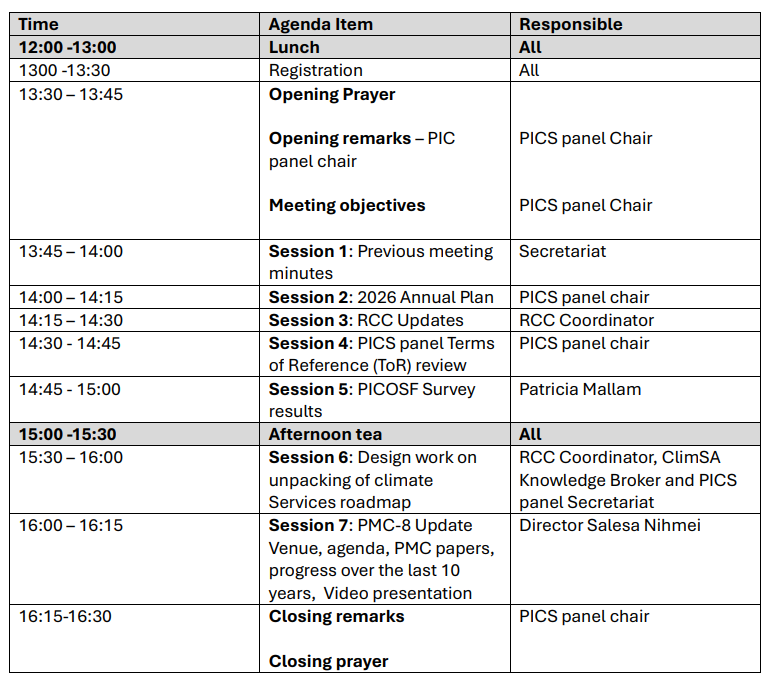
| 1.30-4.30pm | PICS panel meeting (refer to separate agenda - below) | |
Pacific Island Climate Services Panel Meeting
Background
The Pacific Island Climate Services Panel (PICS Panel) was endorsed by the Second Meeting of the Pacific Meteorological Council (PMC-2) to serve in the capacity of an advisory committee to the Pacific Meteorological Council (PMC) on climate services matters in the Pacific region.
The PICS Panel established the WMO RA V Pacific Regional Climate Centre Network (Pacific RCC-N), endorsed by the PMC in 2017 (currently in demonstration mode). The Pacific RCC-N is a virtual Centre of Excellence that assists National Meteorological and Hydrological Services (NMHSs) in the Pacific Islands region to deliver climate services and products and to strengthen their capacity to meet national climate information and service delivery needs. While the Pacific RCC provides operational scientific services to NMHSs for long range forecasting, climate monitoring, climate projections, data services and training, the PICS Panel provides a strategic advisory service, providing the link between the Pacific RCC Management Committee and the PMC.
The purpose of the PICS Panel is to provide non-technical scientific advisory services to the PMC on matters related to the strengthening and coordinating of climate services at the community, national and regional levels and to guide the Pacific RCC-N in implementing the GFCS in a way consistent with Pacific climate service priorities. Future management of the Pacific RCC-N would ideally be delivered by the Pacific RCC-N management committee (with the PICS panel as a member). The Pacific RCC-N would ideally sit alongside the PICS Panel, co-managed by the WMO and PMC.
The role of the PICS Panel, in consultation with other partners, is to provide non-technical advice to the PMC on the following:
The strengthening, coordination, continuity and integration of current and future programmes, projects and initiatives that support climate services at the community, national and regional levels.
The enhancement of avenues and modes of multi-way communication and feedback between climate services providers and users to enhance the uptake and use of relevant and tailored climate services down to the communities and individuals.
Advisory to, and monitoring of, climates services-related projects and programmes in the Pacific that address priority activities outlined in the Pacific Island Meteorological Strategy (PIMS) 2017-2026 (in particular, PKOs 4-6)
Seek funding support for and monitoring of the regional and national actions listed in the "Pacific Roadmap for Strengthened Climate Services 2017-2026”.
Advisory to, operational activities of the WMO RA V Pacific Regional Climate Centre, ensuring consistency with key climate service-related Pacific strategic priorities identified by the PMC and outlined in the Pacific Island Meteorological Strategy (PIMS) 2017-2026 and the Pacific Roadmap for Strengthened Climate Services 2017-2026.
The review of regional climate services needs and capabilities to recommend changes or further development Pacific RCC Network nodes products and services, in the areas of:
Long-Range Forecasting - climate predictions (seasonal and sub-seasonal), climate and multi-hazard early warning
Climate Monitoring (both short- and long-term climate)
Climate Change Projections
Operational Data Services - data and product-based services
Training - relevant to the different RCC nodes
Research and development,
Coordination of activities with other PMC panels, such as the PIAWS, PHS, PIMOS, PICI and PIETR panels.
The regular reporting to the PMC members on the progress of the PICS Panel and on the activities of the Pacific RCC.
Meeting Objectives
- Review last meeting minutes
- Develop PICS panel 2026 annual plan
- Review of PICS panel TOR
- RCC and PMC-8 Updates
- Design workshop details to unpack the Pacific Roadmap for Strengthen Climate Services
Expected Outcomes
- 1. PICS ToR reviewed and updated
- 2026 PICs panel Annual Plan
- PICS panel members update with RCC plan and PMC-8
- A detail workshop agenda to unpack of climate Services roadmap
Attendees
PICS panel Members: Simon McGree, Arieta Baleisolomone, Salesa, Nihmei, Philip Malsale, Sunny Seuseu, Silipa Mulitalo, Maria Ngemaes, Johannes Berdon, Kasis Inape, John Ruben, Alexandre Peltier, Selu Finaulahi, Rossy Mitiepo, Elinore Lutu McMoore, Victoire Laurent, Kamaitia Rubeetake, Brandon Bukunt, Nicolas Fauchereau, Leanne Webb, Jen Stewart, Jin Ho Yoo, Elisabeth Thompson, Awnesh Singh, Moleni Tu’uholoaki
Pacific Regional Climate Centre Network (RCC-N) Designation Planning Meeting Agenda
Date: 24th April, 2026
Venue: Novotel, Nadi, Fiji