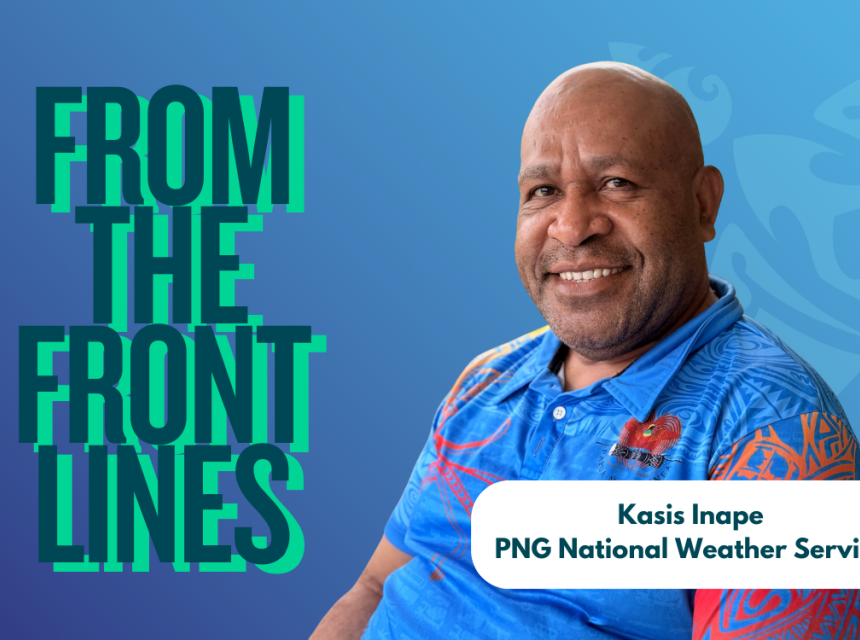
From the Frontlines: Meet Mr. Kasis Inape
Mr. Kasis Inape is one of the longest serving climatologists in the Pacific region. The Assistant Director of Climate within the Papua New Guinea National Weather Service has 32 years of service under his belt. Mr. Inape has been with the Papua New Guinea Weather Service since 1994, and he says that the work still excites him to this day.
Mr. Inape’s journey to where he is today started when he graduated from the University of Papua New Guinea with a Bachelor of Science majoring in Mathematics and Physics in 1993. He joined the PNG National Weather Service the following year and has been serving in the climate division ever since. He also has a Master of Applied Meteorology from Reading University in the United Kingdom and has recently completed a Master of Business Administration from the University of PNG’s School of Business.
As a climate scientist, Mr. Inape is particularly interested in the El Niño-Southern Oscillation. He first learned about El Niño in 1997 when there was an El Niño drought event in Papua New Guinea. At the time, it was a fairly new science to the PNG National Weather Service, and they were not aware that different parts of the country respond differently to an El Niño event.
“We thought El Niño was mostly dry and La Niña was mostly wet, but when I did some extra research, I found out that the northern part of PNG responds in a non-linear way – meaning that during El Niño you will have wetter conditions, and La Niña will bring about drier conditions. The Southern part of the country responds in a linear way, meaning that during El Niño it will be drier, while wetter conditions are to be expected during a La Niña,” Mr Inape said.
He added that through this discovery, they are now able to confidently forecast and pinpoint which locations will be impacted and how during an El Niño and La Niña event. This information also helps the climate team when producing their outlooks.
When asked what his favourite part of his job was, Mr. Inape said he enjoys helping people, and he also loves to travel.
“The work we do is very fulfilling work because we are in the business of helping people, trying to reduce impacts and risks to lives and livelihoods,” he said.
“Also, my favourite part of my job is that I get to travel and meet a lot of new people. My favourite countries are our Pacific Island countries of Fiji, Samoa, and Tonga. I haven’t been able to visit the Northern Pacific yet.”
Mr. Inape said that although Pacific Island countries are all similar geographically, he still finds them exciting to visit because he believes there is much to discover – new things, new people, and new ways of doing things.
As one of the more senior officials within the Pacific Meteorological Community, Mr. Inape said the biggest challenge facing Pacific Met Services is the high turnover of staff and believes that there should be systems in place to address this issue.
“To be a climate scientist, one needs a lot of exposure and work experience to build up your capacity. Nowadays, there is a lot of competition from regional organisations and others, and people are now moving out to find greener pastures elsewhere.”
Once this happens, National Met Services will need to bring in new staff, and will need to start all over again in terms of training them and building their capacity. This is why Mr. Inape believes there should be a retention programme or succession planning programme within our Pacific National Met Services, or they will continue to face this challenge.
He encourages aspiring meteorologists and climatologists from around the region to join the Met Services, saying that it is a very rewarding career.
“We are always challenged with new ideas and new technologies which makes it very exciting,” he said. “Nature is always changing, but as long as you are able to understand the systems the changes happening, you’re always in control. Your knowledge is always being renewed, but you need to be willing to put in the work over time.”
“I always tell my officers, nature tells a story. The story is captured in the data you collect. When you combine the data together, you come up with a story, and that story is your experience,” he concluded.
- Log in to post comments