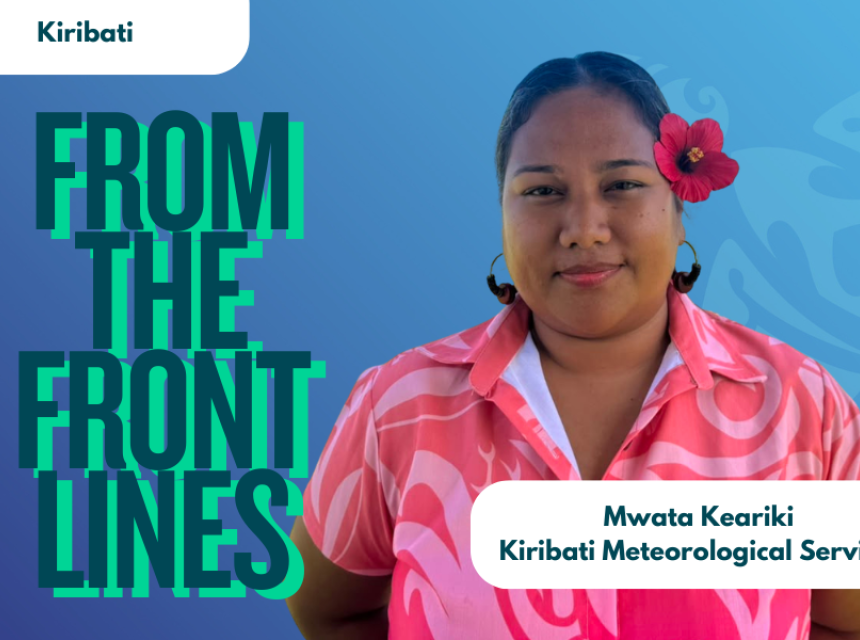
Information Saves Lives: Meet Mwata Keariki of the Kiribati Meteorological Service
For Ms. Mwata Keariki, a career in meteorology wasn't something she had planned. In fact, after graduating from the University of the South Pacific with a Bachelor of Science in Environmental Science, she imagined herself working in the environmental sector.
But sometimes the most rewarding careers begin with an unexpected opportunity.
Shortly after completing her studies, Mwata received a call from the Kiribati Public Service Office asking her to report to the Kiribati Meteorological Service (KMS) the following day to fill a temporary position as an Assistant Climate Officer. It was a role she knew little about, but one that would ultimately shape her career and passion for serving her country.
"At first, everything was new and challenging because I knew very little about meteorology," she recalls. "But I learned on the job, working with the Climate, Observation, and Forecasting teams, and I began to understand how important weather and climate services are."
Since joining KMS in 2018, Mwata has steadily built her knowledge and experience through a combination of hands-on work and professional development. She has participated in several short- and long-term weather and climate training programmes, learning to use key meteorological tools and software including Himawari with SATAID, SCOPIC, PICASO and other specialised weather and climate applications.
Those opportunities have strengthened her technical skills while broadening her understanding of the critical role national meteorological services play in protecting lives and livelihoods across the Pacific.
Her career has also been one of continual growth. Beginning as a temporary Assistant Climate Officer, Mwata went on to serve as Acting Senior Meteorological Officer in the Observation Unit before becoming a Weather Forecaster. In 2021, she secured a permanent position with KMS, where she continues to serve today.
"Each of the roles I took on has helped me learn new skills and better understand the different areas within KMS," she says.
While forecasting and climate analysis form an important part of her work, it is engaging directly with communities that brings Mwata the greatest satisfaction.
She is passionate about helping people understand weather and climate information and how it can be applied in their everyday lives.
"The information itself can be very technical in nature and therefore difficult to understand, but when it is explained in simple language, people can use it to make better decisions and prepare for changing weather conditions," she says.
"Knowing that my work helps people and supports safe communities makes me proud, and motivates me to keep learning and improving."
One experience, in particular, reinforced the importance of her work.
In 2022, a prolonged La Niña event triggered a severe drought across Kiribati, resulting in a national drought declaration due to significant freshwater shortages. As part of the Kiribati Meteorological Service, Mwata contributed to the Government's Drought Committee, working alongside other agencies to provide technical advice and recommendations to support the country's response.
For a nation where freshwater is one of the most precious resources, the impacts were profound.
"That experience opened my eyes and strengthened my understanding of the importance of disaster risk management, climate resilience, and the value of coordinated action in preparing for and responding to climate-related emergencies," she reflects.
Looking ahead, Mwata believes one of the greatest challenges facing Pacific meteorological services is ensuring that weather and climate information not only reaches communities but is communicated in ways people can understand and act upon.
"Although forecasting technology has improved significantly, warnings are only effective if communities receive them in time and know what actions to take," she explains.
"In many Pacific Island countries, limited resources, geographical isolation, and communication challenges make this difficult. As climate change increases the frequency and intensity of extreme weather events, strengthening early warning systems, improving public awareness, and investing in people and technology will be more important than ever."
For young Pacific Islanders considering a career in meteorology or climate services, Mwata has a simple but powerful message.
"Meteorology and climate services are rewarding careers because the work has a direct impact on people's lives."
"Every forecast, warning, and climate outlook can help protect communities, support decision-making, and build resilience. I encourage young Pacific Islanders who are curious about science and passionate about serving their communities to consider this as a career."
As someone who never expected to work in meteorology, Mwata's own journey is proof that careers can begin in unexpected ways, and that following an unforeseen opportunity can lead to a lifetime of making a difference.
"The Pacific needs the next generation of meteorologists and climatologists who understand our unique environment and are committed to helping our islands adapt to a changing climate."
- Log in to post comments