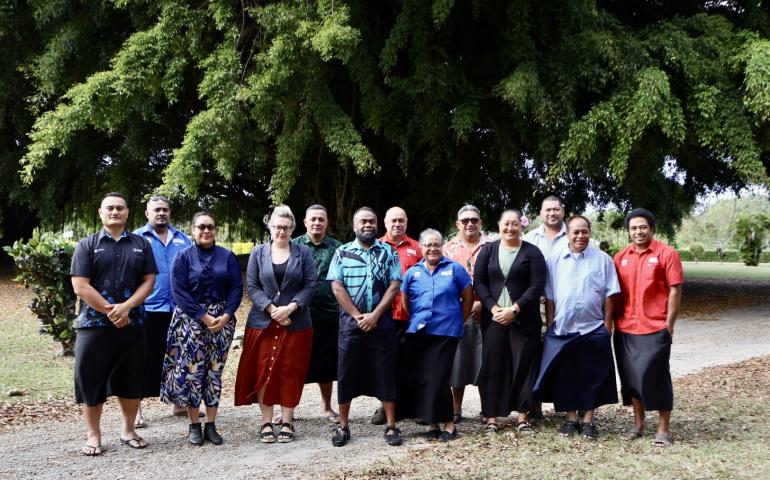
A milestone for Tokelau – First National Climate Outlook Forum Convened
Atafu, Tokelau – History was made in Tokelau this month as the island atoll held its very first National Climate Outlook Forum (NCOF). This brought together experts and stakeholders to develop weather and climate forecasts for communities so they can best prepare.
Having no airport in Tokelau, the only way to reach Tokelau – made up of three low-lying atolls - is by sea. On 27 April, the Weather Ready Pacific (WRP) Programme at the Secretariat of the Pacific Regional Environment Programme (SPREP) coordinated a joint coalition mission to Tokelau, funded by UK WISER. Working with the island atoll and its people was a priority for the Weather Ready Pacific with the mission being the only way to best connect with its people and better understand challenges and daily needs to provide the best support.
"For too long, Tokelau has faced the realities of climate change from the outside, watching the sea rise, feeling the droughts deepen, but without the tools and knowledge systems that other nations take for granted,” said Ulu o Tokelau, Hon. Alapati Tavite, as he officially welcomed the participants of the Forum.
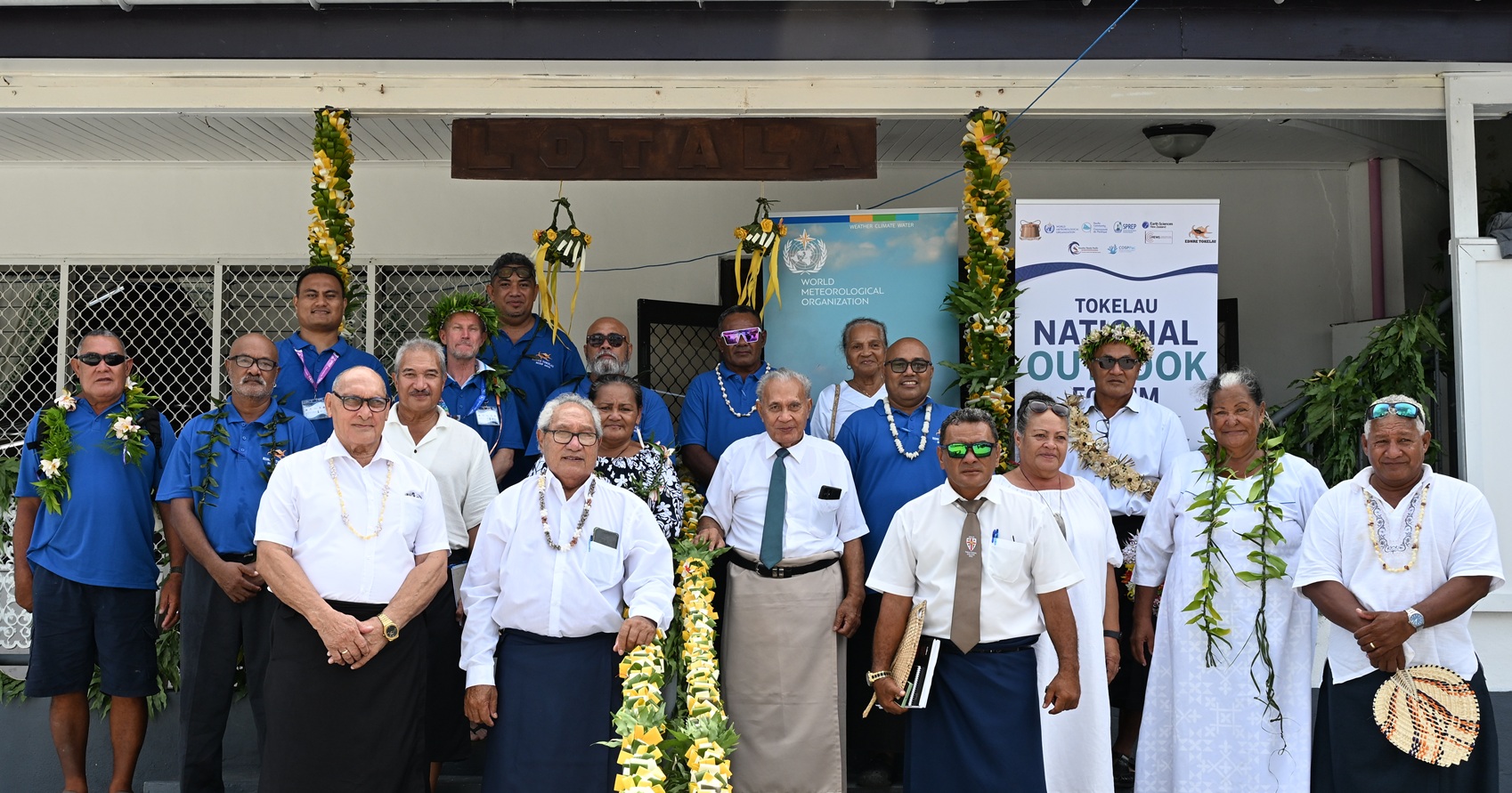
“This is different. For the first time, we are not waiting for information to reach us across the water. The knowledge is here, on our islands, in this room, with our people. That is what this forum means to Tokelau.”
The very first NCOF was held on Atafu on 1 May 2026, bringing together climate scientists, meteorological experts, and community stakeholders from Nukunonu and Fakaofo for an exchange of seasonal forecasts, climate risk information, and the tools Tokelau communities need to prepare for what is ahead.
It provides stakeholders with updated weather, climate and ocean information, strengthen understanding of Tokelau Meteorological Services, and promote their effective use in planning and decision making across the various sectors to enhance preparedness.
“This NCOF has been a long outstanding activity that we have been planning and hoping for, for the past 10 years,” said Ms Asifangalua Pasilio, Director of Economic Development, Natural Resources and Environment (ENDRE) of Tokelau.
“To finally be able to carry out this forum, to meet with our national stakeholders and regional partners, and showcase the services we provide to seek feedback has been so beneficial and we are grateful to have had this chance to find out what the needs of our community is.”
This year, NCOFs have now been held across the Pacific: in Fiji, Tonga, Tuvalu, Kiribati, Vanuatu, Papua New Guinea, Solomon Islands and Samoa. Each one has helped forge vital connections between climate science and community decision-making. Tokelau joins this community of practice for the very first time.
During the NCOF, Tokelau Meteorological Services staff presented the seasonal outlook for Tokelau, stating that the El Niño Southern Oscillation (ENSO) is currently neutral, but a transition to El Niño, potentially a strong one, is likely by mid-2026 and expected to last through to the end of the year.
For the May–July period, below-normal rainfall and above-normal air and sea surface temperatures are forecast, with sea levels near to slightly below normal. There is a 75–90% chance of moderate Marine Heatwave conditions, alongside a Coral Bleaching Watch for the next 4–8 weeks, while the Fisheries Convergence Zone is expected to shift east of Tokelau, potentially improving tuna availability.
In plain terms, what this means for everyday Tokelauans is:
- Water - Rain is expected to be below normal for the next few months, so water tanks and storage may run low. It's a good time to be careful with water use and make sure storage systems are in good shape before the dry spell hits harder.
- Heat - It's going to be hotter than usual. This means staying hydrated is more important, outdoor work should ideally be done in cooler parts of the day, and vulnerable people (elderly, children, those with health conditions) may need extra support and care.
- Fishing - The good news is that tuna may actually be more available and closer to accessible fishing areas over the next few months, so fishing conditions could improve in the short term.
- Gardens and crops - Less rain and more heat is a tough combination for growing food. Crops may struggle, so it's worth protecting plants where possible and prioritising water for food gardens.
- Health - Warmer ocean waters raise the risk of ciguatera fish poisoning, which comes from eating certain reef fish. It's worth being cautious about which fish are eaten, particularly larger reef species.
- Coral and the ocean - Reefs are under stress from the warm water, which matters for the long-term health of fish populations and coastal protection.
The main message of Tokelau’s NCOF for 2026 is: conserve water now, prepare for heat, and keep an eye on food and water security over the coming months.
“Tokelau would benefit from support through training, and to be part of a system where seasonal forecasts are produced, communicated, and used. Where the meteorological officer on the atoll is connected to the community they serve, and provide information on time that means they can prepare for the dry months ahead, for king tides, or for seasons when the fish move and water tanks may run low,” said Mr Henry Taiki, WMO Representative for the South-West Pacific. “The NCOF represents a big step towards this, which Tokelau has long needed but has been delayed due to the challenges of getting there.”
Planning for the NCOF began following initial staff exposure in 2025, supported by Earth Science New Zealand (ESNZ) under the Climate Risk and Early Warning Systems (CREWS) 2.0 Pacific Project and Climate and Ocean Support Program in the Pacific (COSPPac). These efforts have since been scaled up through the WMO CREWS Drought Resilience and Early Warning (DREW) Pacific with the aim of delivering the NCOF on island and led by Tokelau’s own Meteorological staff, more than 50% whom are women. The models and products were co-developed and prepared by ESNZ and SPREP through the COSPPAC Project with a special focus on Early Action Rainfall Watch (EAR Watch) Bulletins.
“We are pleased to be able to support the Tokelau NCOF with our expert teams and bring our partner organisations such as WMO, the Pacific Community (SPC), Bureau of Meteorology (BOM), ESNZ, and United Nations agencies including WMO, UNDP and UNICEF, and Government of Samoa officials who also joined the mission,” said Mr Salesa Nihmei, Director of SPREP’s Climate Science and Information programme.
“Tokelau deserves the effort and support our other more easily accessible Pacific island countries receive, and we hope this mission will not be the last of its kind. We have learned so much on this short journey, and we still have much to learn from Tokelau about strength and resilience.”
Tokelau First NCOF is supported by the Climate Risk and Early Warning System (CREWS) funded WMO Drought Resilience Early Warning (DREWS) Pacific Project, ESNZ, and SPREP.
It was opened by the Ulu o Tokelau, Hon. Alapati Tavite, the Hon. Malala Lafaialii, Minister of ENDRE followed by remarks from the United Nations Resident Coordinator (UNRC) Samoa, Ms. Karla Hershey, on behalf of the World Meteorological Organisation (WMO) Representative Office, Samoa.
The mission departed Apia, Samoa for Fakaofo, Tokelau on 27 April, 2026, and concluded on 3 May, 2026. It was led by SPREP under the WRP, with funding support from UK WISER. The NCOF is supported through the WMO CREWS DREW Pacific Project with the technical support from ESNZ and SPREP through Climate and Oceans Support Program in the Pacific (COSPPac) and WRP.
About EDNRE & Tokelau Met Services
The Government of Tokelau’s Department of Economic Development, Natural Resources and Environment (EDNRE) is responsible for the management and oversight of the country’s environment, weather forecast, economic development, and agriculture. Tokelau’s Met Services falls under this department, and is led by Director Asifangalua Pasilio, to serve all three of its atoll islands: Fakaofo, Nukunonu and Atafu. For more information or to contact EDNRE please contact Ms Asifangalua Pasilio, Director of EDNRE, [email protected] or Ms Mile Fonua, Manager of Environment Division, EDNRE, [email protected].
About CREWS DREW Pacific
The Drought Resilience and Early Warning (DREW) Pacific Project is a four-year CREWS-funded regional initiative implemented by the World Meteorological Organization to strengthen drought early warning systems and climate services across Pacific Island countries. The beneficiary countries include Cook Islands, Kiribati, Papua New Guinea, Samoa, Tokelau, Tuvalu and Vanuatu.
For more information about the CREWS DREW Pacific Project please visit WMO webpage for the project or contact CREWS DREW Pacific Project Officer, Ms. Tessa Tafua-So’o, [email protected] or the WMO Head of South-West Pacific Representative Office, Samoa, Mr. Henry Taiki, [email protected]
About COSPPac
The Climate and Oceans Support Program in the Pacific (COSPPac) is a long-running regional Project in its third phase supporting Pacific Island stakeholders to use climate and ocean information to enable Pacific peoples to remain resilient to the impacts of climate change and disasters so they are able to lead safe, secure and prosperous lives funded by the Government of Australia and New Zealand.
The program works directly with national meteorological and hydrological services (NMHS) and land survey departments (LSD) in fifteen Pacific Island countries and territories, supporting them to deliver useful and usable climate and ocean information services in partnership with priority stakeholders, including affected communities and marginalised groups.
For more information, please contact Mr Philip Malsale, COSPPac Senior Climatologist [email protected]
About Weather Ready Pacific
The Weather Ready Pacific Programmed is a decadal programme of investment managed by the SPREP endorsed by Pacific Leaders aimed at strengthening hydrometeorological services across Pacific countries and territories. WRP is committed to Pacific-led, inclusive, and transformative approaches to weather and disaster resilience. Financial support for the programme is provided by the Governments of Australia and New Zealand, and the Weather and Climate Information Services (WISER) of the United Kingdom.
For more information about the WRP Programme or the Niue COPE Booklets, please visit the SPREP website or contact WRP Programme Manager Mr Ofa Fa'anunu, [email protected] or WRP Programme Communications & Knowledge Management Officer Ms Angelica Salele-Sefo, [email protected]
- Log in to post comments