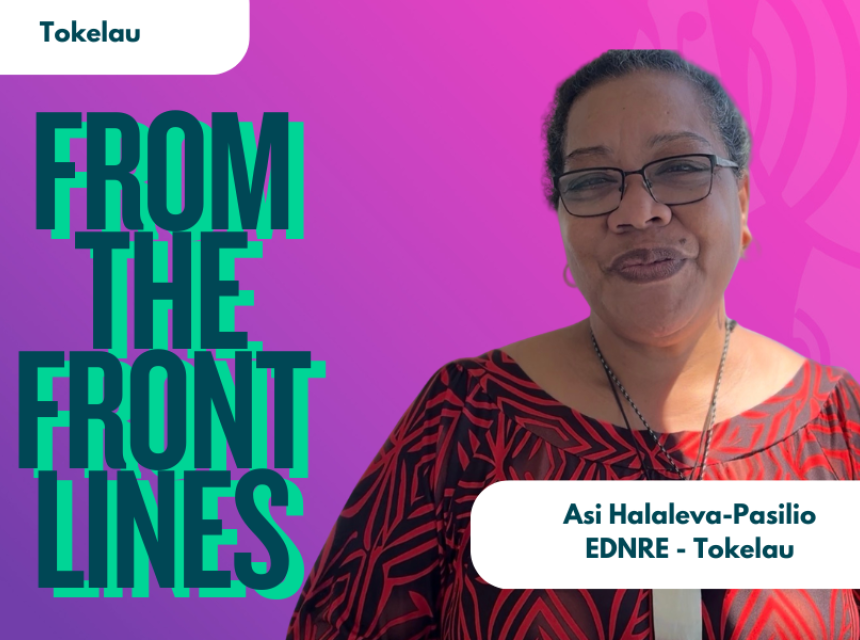
From the Frontlines: Meet Ms. Asi Halaleva-Pasilio
Ms. Asi Fangalua K Halaleva-Pasilio’s story is a rather interesting one – born and raised in the Kingdom of Tonga, currently residing in Nukunonu, Tokelau, and fluent in Tonga, Tokelauan and Samoan.
Ms. Pasilio is the multi-faceted, multi-talented female powerhouse at the head of the Tokelau Meteorological Service, under the Department of Economic Development, Natural Resources and Environment (EDNRE).
Ms. Pasilio has been serving Tokelau as the Director of the EDNRE for the past two years and nine months. A graduate of the University of the South Pacific with a Bachelor of Arts in Business Studies and the University of Auckland with a Master of Arts in Public Policy, Ms. Pasilio said she started working for the Department mainly because they were looking to recruit someone with a financial background to improve the Department’s financial performance.
“That is how I started in this role 3 years ago, and I am proud to say that after a decade of operating on a budget deficit, the Department has not overspent since I joined,” she added.
“The best part of this role, working in the Met Service, is that I am getting to learn so much about climate science and its fundamental role in community and national safety from natural disasters and climate change,” Ms. Pasilio said.
According to Ms. Pasilio, she is inspired by the passion she sees within her fellow Directors and also everyone in the Pacific Meteorological Community who are passionate about the work that they do and its impacts on Pacific communities.
“Being part of the Pacific Met Community, and working closely with people who genuinely love their work and how it contributes to saving the lives of our people is the best part of this job,” she said. “I have learnt so much from them.”
When asked about what she sees as the biggest challenge facing Pacific Meteorological Services, Ms. Pasilio mentioned that for small Met Services like Tokelau, the challenge lies in identifying priorities of each Met Service and providing the relevant support needed. The priorities of smaller Met Services are vastly different from those of larger and more well established Met Services, and so some of the support may not be relevant for smaller operations like theirs.
“Another challenge is recruitment and retention of staff, ensuring that we have the technical expertise at all times to maintain and keep the service running.
It is for that reason that Ms. Pasilio wants to encourage the younger generation, not only of Tokelau but the rest of the Pacific, to consider a career in meteorology or climate science.
“I strongly urge our children to pursue and make climate science their field of study,” she said.
“Climate change is not going away, and our environment is one of the most vulnerable now. We need the relevant expertise and graduates to provide the right information and guidance to decrease the impact of climate change on our Pacific communities.”
- Log in to post comments